
Fugue-ing
Bach as antidote.

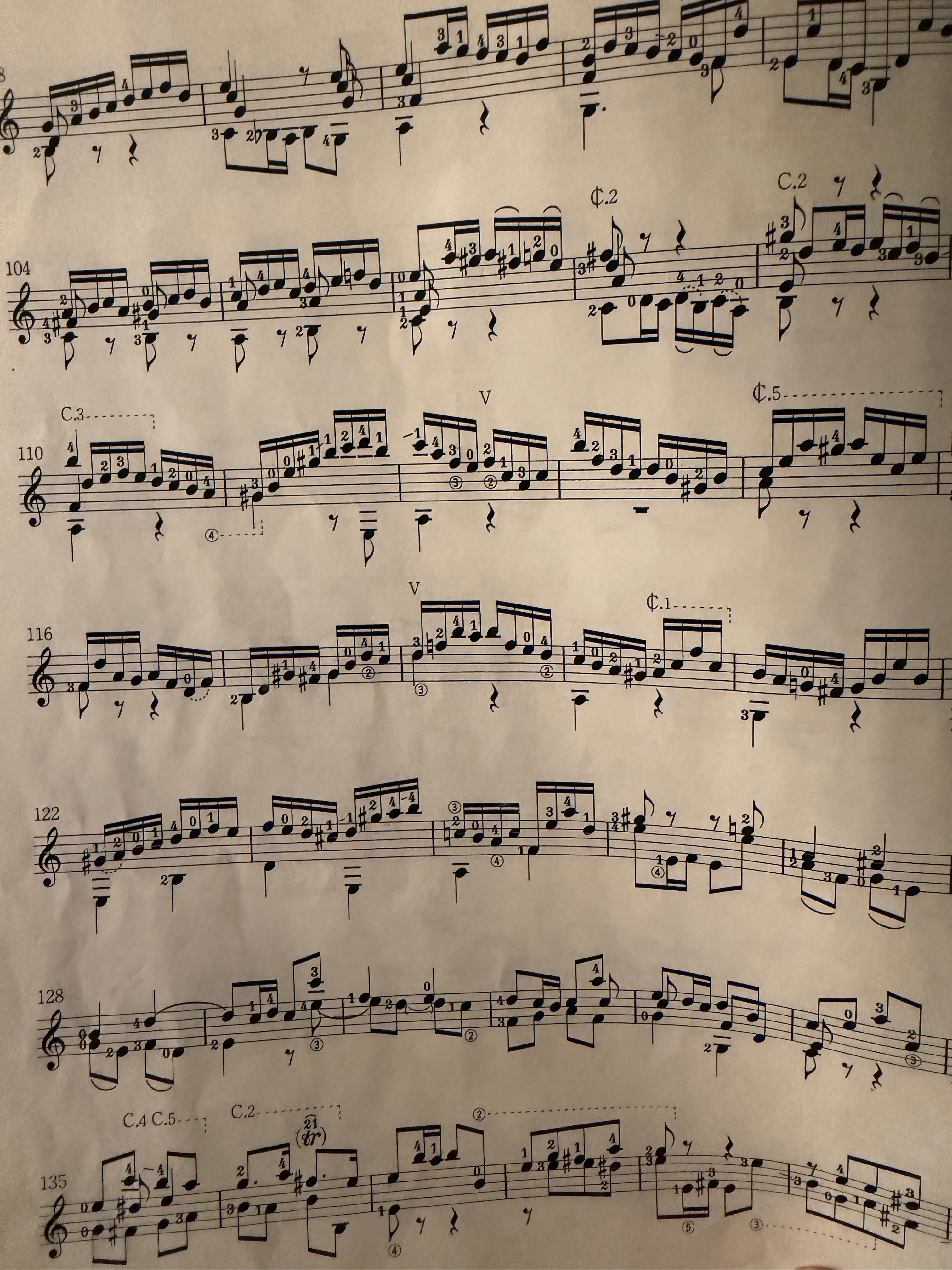
At the height of COVID, I picked up a book of Bach Sonatas and Partitas for solo violin arranged for classical guitar by Tadashi Sasaki…and as hospitals filled across the globe and the number of deaths steadily climbed—and all normalcy vanished from my life—pouring myself into sight reading these, finding recordings of them, attempting to slowly play the not quite impossible pieces…became a necessity, an immersion into Bach’s pure musical genius that filled a void. As humanity stumbled along, very likely victims of our own carelessness, the future becoming more and more uncertain…I dove headlong into the heart of human beauty, invention, skill, artistry, complexity.
And lately, as during COVID, my time spent adjusting fingerings, playing extra slow, leaning over the often indecipherable small black dots of notes, lines, in front of a roaring fire, a few cats absorbing heat nearby, dogs draped in varying poses of utter comfort on the big, too-soft sofa, the occasional bar or two I manage to play well—has once again become a critical respite from the current epidemic, this one surely of our own making—one of violence, hatred, stupidity, inhumanity…that plagues our country.
Most recently, I have become obsessed with Bach’s fugues (in both the lute suites and violin sonatas). Before I did some quick, focused research on what constitutes a fugue (and what makes Bach such a master of the form), I could already feel/sense the repetitions, inversions, counter melodies, themes, voicings….
In my latest favorite fugue from violin Sonata #2 (BWV 1003 in A Minor), the inner workings and complexities of the piece hit my ear even on a first painfully slow attempt. And I concur with a YouTuber, whose name I can’t remember, saying that playing Bach slowly is always preferable to playing at tempo and making mistakes—that his music is so transcendently lovely, it works at any tempo. Here, I’m also reminded of a conversation I had with the renowned classical guitarist, and very old friend of my wife’s, Morgan Szymanski (she once baby sat for him), who shared an old expression amongst musicians, “when the angels sing for God, they sing Bach. But when they sing for pleasure, they sing Mozart.”
One thing I sensed right away was how the piece establishes musical expressions, then sets about recasting each in a harmonically dynamic way with the effect being an echoing, tumbling, meandering yet always controlled string of phrases, harmonies, mode (and mood) shifts…each microcosm reflecting and restating in a new yet adjacent way the whole of the expression—a poignant, ever-accumulating, snowballing yet always centering…of emotive force. When I play it and take careful note of the musical structure, I can’t help but think of a masterful work of literature—a poem or story, novel or essay or play—that “remembers” its thematic shape throughout so each small part reflects and expands upon the meaning of the whole.
And while hearing the piece played well by a virtuoso performer surely teases out and lays bare the pure genius of the music, there’s something about attempting to play it yourself that has a different effect. Something about the black shapes of notes and the circled and un-circled numbers and latin numerals of guitar fingering notation on the page taken in through my eyes, on into my brain, then moving down along the nerves to my hands and fingers, all circling back to the sounds I’m making coming in through my ears, finding their way back, again, to my brain…heightens the experience indescribably. Immersion isn’t a strong enough word for it.
I began playing classical guitar in college when I chanced to go to a solo recital of a nearby Crane School of Music student. I was so moved by the performance, I went up to him after and asked if he gave lessons. I had played guitar for years already at that point, playing bluegrass, rock, folk on a lovely old Guild I had found a way to buy…. Soon, I traded that guitar for a cedar and mahogany Yamaha Grand Concert classical and started taking weekly lessons, learning to read classical guitar music, poring over Segovia scales, growing out my nails.… In my senior year, I gave a recital of Vivaldi’s Concerto for Guitar and Orchestra in D Major with a local orchestra. Since then—through various rock, punk, folk-rock “phases” (read about some in my self portrait in guitars posts), my classical guitar has always remained centrally dear to my heart.
Almost a year ago now, I finagled another classical guitar acquisition, an all hand-built masterpiece of cypress, redwood, mahogany, bloodwood…lovingly cut and sanded, glued and shaped and polished into existence by Adirondack luthier Bruce Thompson. I got the guitar fresh out of the shop, the French polish not quite dry, in order to use it on this recording I did for Marc Osborne of my sometime-band, Hand. Since then the guitar has become richer and more complex each time I play it, the strings sending sound waves vibrating across and through the woods, making them steadily “open up,” as they say.
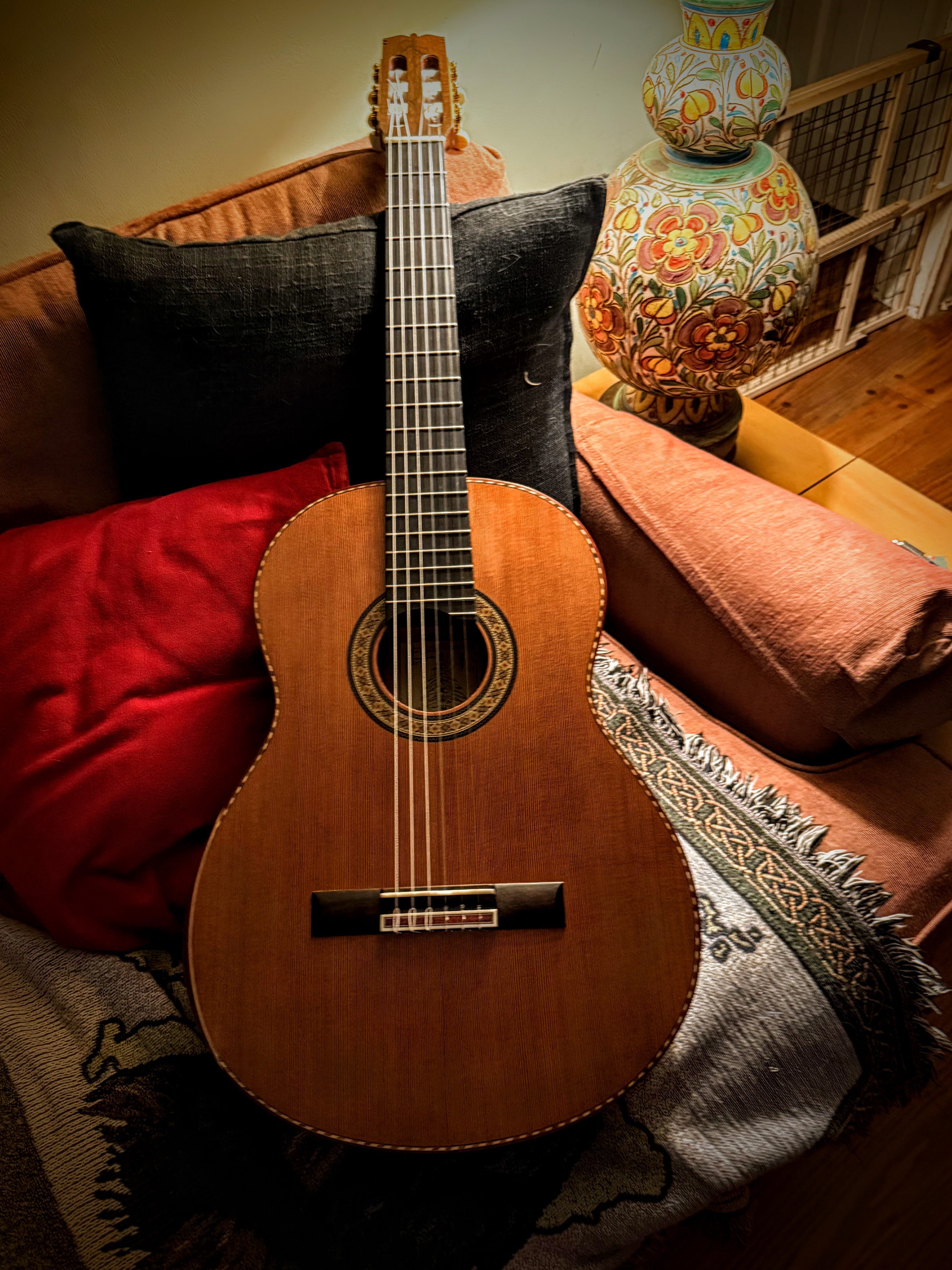
Meanwhile, I keep plucking away at Bach, hoping to reach a point where I feel more worthy of playing such beautiful music on this beautiful instrument. Even though I’ll certainly never achieve virtuosic mastery, each small moment of beauty that wends its way from the page, fingers, out through the woods of my guitar helps fend off the on-rush of its polar opposite—the real-life “idiocracy” that bludgeons us daily in these trying times.
Here’s me slowly working through a new fingering of a section of the A Minor fugue mentioned above:
Here’s a lovely (and very much faster—perhaps a little too fast—than I will ever play it) version played by Paul Galbraith on an 8-string guitar.
If you’ve been enjoying my writing, please consider doing any/all of the following:
Help me grow my audience by Sharing this post or my main site with a few people you think might enjoy it as well.
Subscribe or Upgrade your subscription to paid. For only $.14/day, you can help me continue to devote the many hours I do each week to writing, editing and promoting this page.
JourneyCasts is a reader-supported publication. To receive new posts and support my work, consider becoming a free or paid subscriber.
You can also help a lot by making a one-time contribution at any time by “buying me a coffee” (or two). And certainly a good amount of real coffee has gone into the making of JourneyCasts.
As always, I encourage you to leave a comment.
Be sure to check out my podcast, “Hemingway, Word for Word.”
Your very best !