
Off Season
A free-flowing contemplation on feeling "off" when not at my Adirondack cabin.

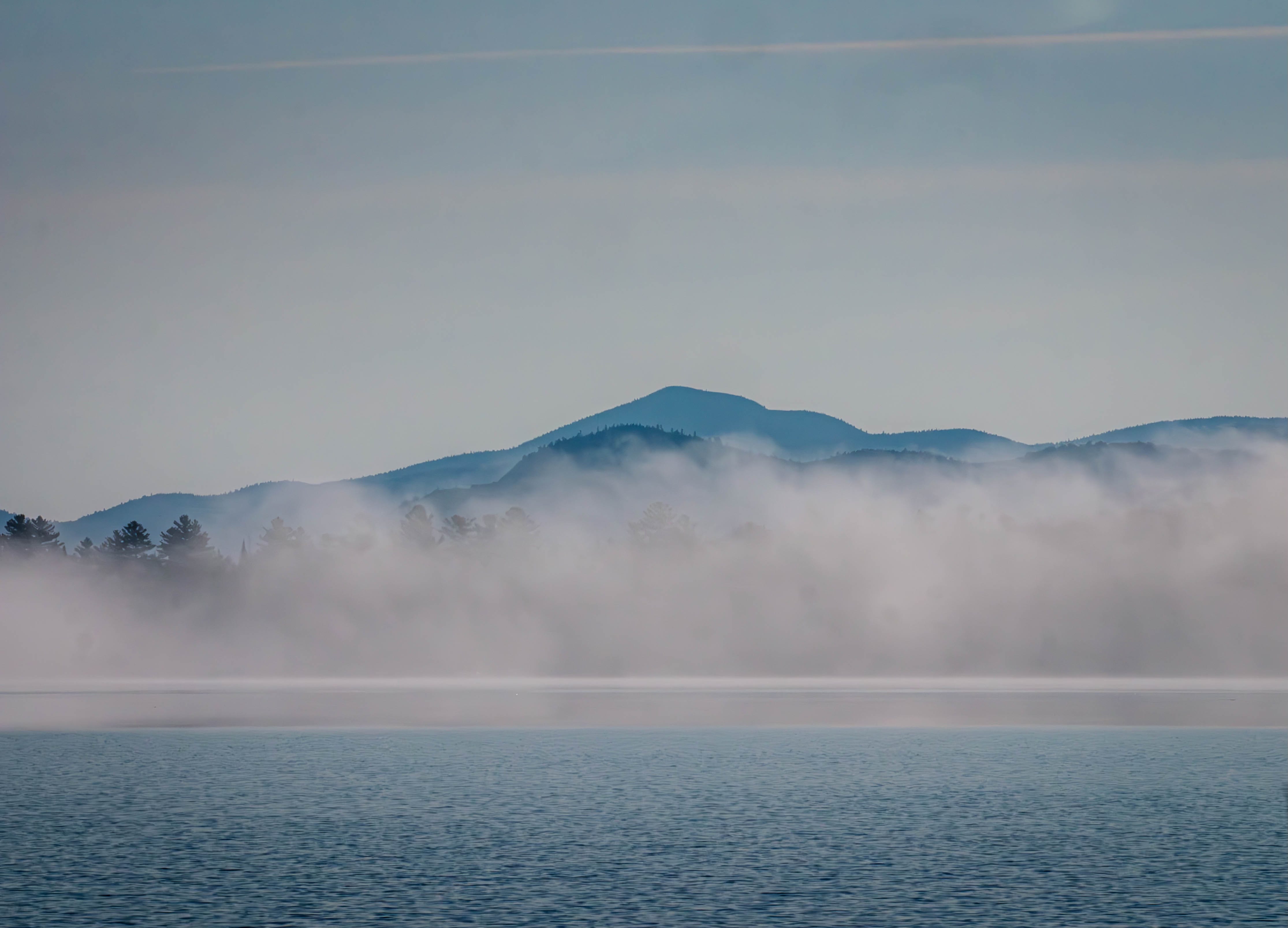
Off kilter, off balance, off color, off hand, off duty, off key, off road, off putting, off and on, off the rails, off the handle, off beat, off the bat, off course, buzz off, carry off, cut off, kick off, knock off, laugh it off, written off….just off.
“Off season” is apt, boats stored away, the snow not quite deep enough for snowmobilers, ice not yet thick enough for anglers to walk out onto, bore small holes, lower their bait and wait.
The ice also isn’t safe enough to make the mile crossing to my cabin, the snow in the woods not good for manageable cross country skiing while pulling a sled.
So much is off. No canoe or sailboat jaunts. No quick plunges in the lake after a sweaty walk. No walks up past the abandoned beaver pond that has become landmark, a centering place I go to in my mind when I need to relax, where late this past summer a beaver had come and spent some time gnawing down trees, dragging them into the water, perhaps pushing them into the invisible-to-human-eyes, submerged parts of the old, ramshackle lodge pond center. But at some point before the leaves turned he had left, given up, decided this particular pond was not worth reclaiming—unless a coyote or fisher cat, big bobcat, or perhaps even a vagrant timber wolf…found him out, descended suddenly from the dark of the forest before he could slap a tail-warning and flee into the water where all his awkwardness vanishes and he becomes sleek and fast again.
I once photographed a small beaver there who had even begun repairs on the dams, built a secondary pond below the big dam I had inadvertently thought was just a tangle of branches from a torrential rain that was pushing water out into the center of the trail where it cut a groove, a new stream bed into the center of the trail. I first learned of its presence when I brushed away a jumble of twigs, cleared away branches and mud and stones, so the outflow returned to its normal course well off to the side of the trail, then down a few hundred feet into the lake. But the next day the branch tangle was back, and I cleared it again, and then, on the third day, it was built with more obvious intent, branches stacked higher, interwoven, and we realized a beaver had returned. Sadly, it was gone come spring, but not before I stalked it, waiting and waiting one cool evening, heard a splash and with a long lens managed a few blurry, uninteresting shots.
The beaver pond is the first landmark on our three-mile, out and back, near-daily when the season is “on,” hike. There are many others—the chainsaw chain someone managed to get pinched in the midst of a large yellow birch, the chain now rusted and hovering half in, half out of the trunk, the cut it must have made healed and grown in around it. It tells the story of someone who dismantled their saw, removing the blade, slipping the saw out, only sacrificing a chain.
Nearby is the big chaga mushroom up some 20 feet high, its black, dried lava-like surface unmistakable in the first high V of the trunk. One day I’ll bring along a ladder or finally get me one of those tree climbing rigs that deer hunters use and harvest it and break it into two-inch chunks and toss a handful into hot water, let steep, drink deeply that earthy, birchy-rich dark brown liquid you can just tell is good for you, is feeding you in ways most of what we imbibe these days cannot.
Other chaga lie just beyond the first bridge crossing, most of its horizontal boards rotted away or so far gone you dare not step on them, so you take care to step along the 4x4 sub beams that still seem (mostly) in tact. The dogs somehow manage to sprint across it without looking down, even with twice as many feet to worry about. Then comes the second bridge, just starting to show a few signs of rot, but with a thin, invisible layer of algae/slime, so even when it gets slightly damp, it is slick, and the dogs spin-slide their way across it on damp or rainy days. One time I spied small fish, possibly salmon fry, in the deeper pool just to one side of the bridge, holding steady in the current, rising to the surface to examine more closely the bit of twig I tossed in above them.
Other landmarks include all the places I have found good, choice edible mushrooms, the summer chanterelles that grow mid trail, the purple lacarria I found just off the trail at one turn a few summers back now, though I’ve not seen them since. The places where I’ve found blue staining boletes or scarletina boletes growing singly, large, brazen, so lovely and hard to miss. A mile or so in, we come to what we refer to as the “dog beach,” the place where a path leads just a few yards down to a shallow stretch of the lake, a very small patch of sand (beach), the place the dogs run ahead to wait for us to arrive armed with sticks I toss out far enough to get our big Gordon Setter, Charlie, to have to swim, while Prudy, the lab-mutt rescue waits for him to do all the work, then steals the stick from right out of his mouth and dashes up the bank and into the forest with Charlie in hot pursuit; this is where you come to fall chanterelle or “yellow foot” territory, a mushroom whose small, brown, fluted crowns are almost identical to the color of the fallen leaves. In wet, warm falls, they can be so abundant I bring home baskets-full, spread them on cookie sheets and dry them on the top of the wood stove, put them in canning jars to cook with throughout the off season.
This past summer, though, was so dry, the yellow foots never emerged, and with none of them to rehydrate, sear and brown, fold into an omelette, this off season feels still more “off ” than normal.
“Off” says a lot about how I’ve been feeling of late, wet winter Connecticut cold coming a little too soon, the light retreating faster and faster, so mid afternoon becomes evening becomes night in a breath of time.
I pull up Google Maps, shift into satellite mode, scroll far north and west of here, up to where the veins of roads vanish and all is a mass of green and the black circles and the twisting, amorphous shapes of lakes, zoom in and find the rectangle of our cabin roof, slide my finger left, west, zooming in and out through all those roadless miles, reminding myself of the infinitesimal portion of it that has become so familiar and how all that unseen but present wildness has become so essential, remembering how it feels to bushwhack back into it all, following small colored squares hunters have nailed to trees to find their way. Some are metal, some plastic, and I like to imagine these indicate hunters from different lifetimes, timelines, eras. Sometimes I’m hunting mushrooms, but other times I’m just hunting, as when I followed alongside a series of beaver dams and small ponds, up and up, till I came to a larger pond, finding my way where no discernible trail existed, pushing away spider webs with a makeshift walking stick, finally coming to a soft, mossy place to sit, lean against a big pine and look out at the water, as if I were the only person who had ever laid eyes on this place. I remember the quiet the most from that day, the immensity of it. When I’ve paused mid-winter, mid-lake, leaning my armpits into ski poles, an even quieter hush descends.
Going west on Google Maps, I come to the big floodwaters of Bog Lake, a place I have canoed into and fished. Looking carefully, I find the course of the 30-something mile gravel bike ride I did in the fall of this year, in past Low’s last remaining dam, on through the newly abandoned Boy Scout camp, down a turnoff to a clearing atop a high bluff overlooking Low’s Lake a camp neighbor has told me how to find on my bike, a place I had only ever paddled into. The day was as perfect as they come, and several early cold snaps had even driven away the last of the biting insects.
When I got to the outlook, when I stopped and leaned my bike against a pine and walked across the soft, silent carpeting of pine needles, when a pair of loons came calling out an eerie accompaniment, when the sun came half out from behind a long line of cumulus clouds warm against my skin in the just beginning chill of the afternoon, when I slid part way down the dirt embankment to sit on a large rock that looked made for just that and ate a granola bar and drank my salty sugary cyclists drink from my bidon, looked, listened, ate, drank, felt my heartbeat slowing into calm, steady rhythm….. I felt “on.”
For now, I watch the fire in my old soapstone stove here in Connecticut, in this the “off season.” I pull out my classical guitar, painstakingly constructed from mahogany, redwood, cypress by a luthier in the Adirondack mountains not an hour from my cabin. I’ve been working on my tremolo technique, enjoying the simple yet elegant (and difficult to master) monotony of it, working to train my fingers to move faster, yet still sustain the illusion of the long, singular legato of a violin, to make the second beat the stressed beat, the melody coming from the never-ceasing triplets of ring, middle, index, fingers, the thumb doing something all its own. Pepe Romero describes it as riding a tiny bicycle with your fingers, the way they circle down, grab the string, then circle back up again.
If you’ve been enjoying my writing, please consider doing any/all of the following:
Help me grow my audience by Sharing this post or my main site with a few people you think might enjoy it as well.
Subscribe or Upgrade your subscription to paid. For only $.14/day, you can help me continue to devote the many hours I do each week to writing, editing and promoting this page.
JourneyCasts is a reader-supported publication. To receive new posts and support my work, consider becoming a free or paid subscriber.
You can also help a lot by making a one-time contribution at any time by “buying me a coffee” (or two). And certainly a good amount of real coffee has gone into the making of JourneyCasts.
As always, I encourage you to leave a comment.
Be sure to check out my podcast, “Hemingway, Word for Word.”
Beautiful !