

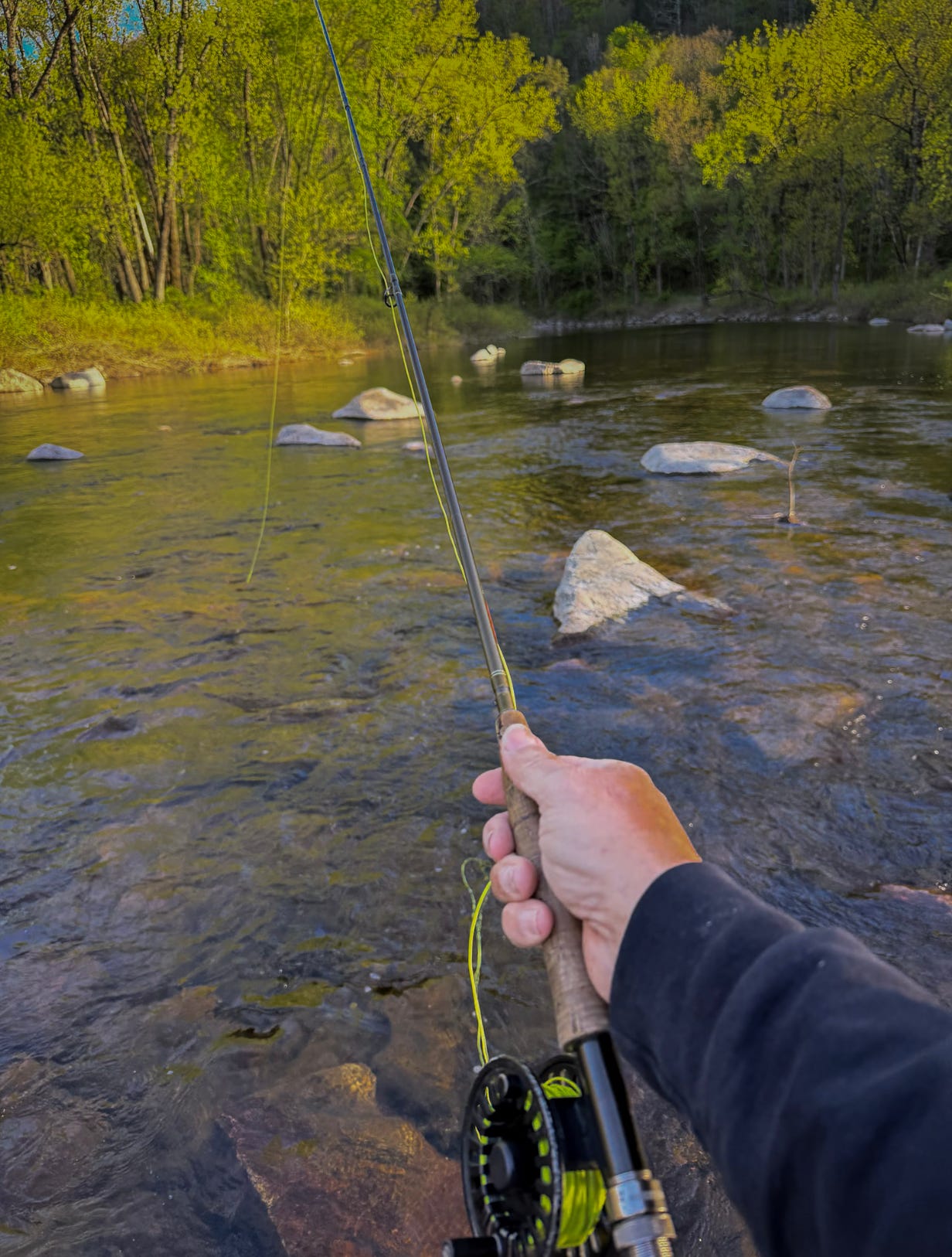
Whenever I saw him, which was all too infrequently over the years, we would always manage at some point to ease into the steady back and forth of fly-fishing talk. We quickly discovered our shared (and divergent) philosophies, recalling experiences most people outside the fly fishing world have little to no interest in—favorite flies, rods, fish. Pointing out the window toward the woods, I loved to talk of the native brookies I caught year’s back after a short bushwhack to the stream out behind my wife’s cousin’s house (the only place I’d ever see him, at holiday and other gatherings there)… or catching bluefish and striped bass on big streamers and popping flies from my kayak in Long Island Sound, often in the dead of night. He would always return to fishing a short stretch of the Farmington River near the Connecticut/ Massachusetts border, how he’d use a 3, or even a 2-weight rod, and how more and more often these days, he’d only fish a small, olive Wooly Bugger fly tied with strands of krystal flash extending down its sides, on into its bushy, marabou tail.
Unlike many a tall-tale-telling fisherman, Tom told his stories in his always soft-spoken, sometimes barely-more-than-a-whisper of a voice, not bragging but only working to honestly convey the deep passion we shared for catching fish with our long, wispy rods on light lines. I tie my own flies, mostly, but Tom preferred to purchase his, to spend fishing time devoted solely to the act of fishing. I don’t think he had ever cast a fly in salt water, preferring the kind of fly fishing I grow more and more fond of with the passage of time—to fish more intimate waters you can see clear across, like that sliver of the Farmington rolling over rock and boulder and pebble, falling into deep pools and finally finding its way down into a large reservoir.
~
When Tom died, I was struck, as always, with fate’s absurdity—that so many good, exceptional human beings are taken so early, while other corrupt and despicable people live long, treacherous lives. And after he died, I discovered still more about him, things I wish I had known when he was alive—he recorded his own, original music in a make-shift studio in an attic space of his large, half-remodeled Victorian house he had been working on for decades not far from me…he liked to paint in the small, high tower-room of that house, looking out across Waterbury…he had loved camping and canoeing, and he and his wife had made numerous trips to the Rangely region of Maine, an area I’m particularly fond of…he bought his own mini-wood mill to turn an enormous, fallen Maple into lumber…he converted a canoe into a small sailing vessel….
When his wife offered me his fly fishing books, gear, fly rods, I was extremely grateful, and it was especially moving to unzip one fly rod case to see a lovely little 3-weight rod and an olive Wooly Bugger tied to a tippet section of the brown, Hard Mason line I knew Tom was particularly fond of.
I knew what was to be done, the only thing for a decent, fellow fly angler to do.
So. A few weeks back, while returning from my cabin, I took the short diversion to Tom’s spot. I pulled on my waders and vest and jointed up Tom’s rod, the one with the Wooly Bugger still attached. I gave the line a quick tug to make sure the knot would hold, that the line was still strong enough, and soon I was up over my knees in the quick-moving stream, casting out to the seams and still-water lies where I knew fish might be. It was a long time since I’d stood in a trout stream, too long I instantly realized. I have so missed the sound of the stream echoing up into the late-afternoon, sun-tipped hills, the cold of the stream pressing against me, scraping my felt wading shoes over the slick rocks to find a secure foothold, the expectation that comes with making a nice cast, imagining the fly sinking, hesitating in place as I flipped a slight mend into the line, knowing, remembering that moment when the fly would start to swing and a trout might lift up and take hold.
I worked my way down stream, missing a few strikes that could also have been rock edge, sand spit. And then I heard a splash that stood out from the steady rush, looked downstream into the big, deep still-water I had been inching toward to see the concentric circles of a nice rise dissipate and drift slowly away. I took out my wading staff and cautiously found my way through increasingly deep water to just within casting range, and as I waded, I noticed the dimples of rises and splashy gulps coming now in steady rhythm all along the far shore.
I made a long cast, sneaking in a short double haul on Tom’s barely-there-at-all rod, saw the Wooly Bugger plop down almost exactly where I had wanted it to, and almost instantly a fish was on, the light rod full-bent, the fish heavy on the other end rushing upstream against the current, finally coming to hand, slick-skinned and glimmering green and blue haloed reds and white-streaked dorsals, white-white belly and big eye. A lovely, 14” brook trout.
I caught four, maybe five more, all about the same size, so very likely they were stocked—all to the consternation of several spin fisherman who arrived just down stream and started chucking large metal things up tight to the far bank to no avail. When I caught nothing on several nice casts and perfect drifts, I examined Tom’s fly to find that the hackle had come loose, and it was trailing a long section of feather. I plucked it away and caught another, the chenille and marabou alone doing plenty to get the job done.
Eventually, I reeled in, slipped the fly around and hooked it up along the lip of the reel and stood there for a good long time, the river flowing all around me, the fish continuing to feed, and Tom’s rod tucked up tight under my arm, feeling my small act of tribute send a well of emotion rising to the surface, considering the tender blessing of this small stream, of simple, sacred gestures that keep us human and bring us more fully to life before we, too, must leave it behind.
If you’ve been enjoying my writing, please consider doing any/all of the following:
Help me grow my audience by Sharing this post or my main site with a few people you think might enjoy it as well.
Subscribe or Upgrade your subscription to paid. For only $.14/day, you can help me continue to devote the many hours I do each week to writing, editing and promoting this page.
JourneyCasts is a reader-supported publication. To receive new posts and support my work, consider becoming a free or paid subscriber.
You can also help a lot by making a one-time contribution at any time by “buying me a coffee” (or two). And certainly a good amount of real coffee has gone into the making of JourneyCasts.
As always, I encourage you to leave a comment.
Be sure to check out my podcast, “Hemingway, Word for Word.”
Loved this.